

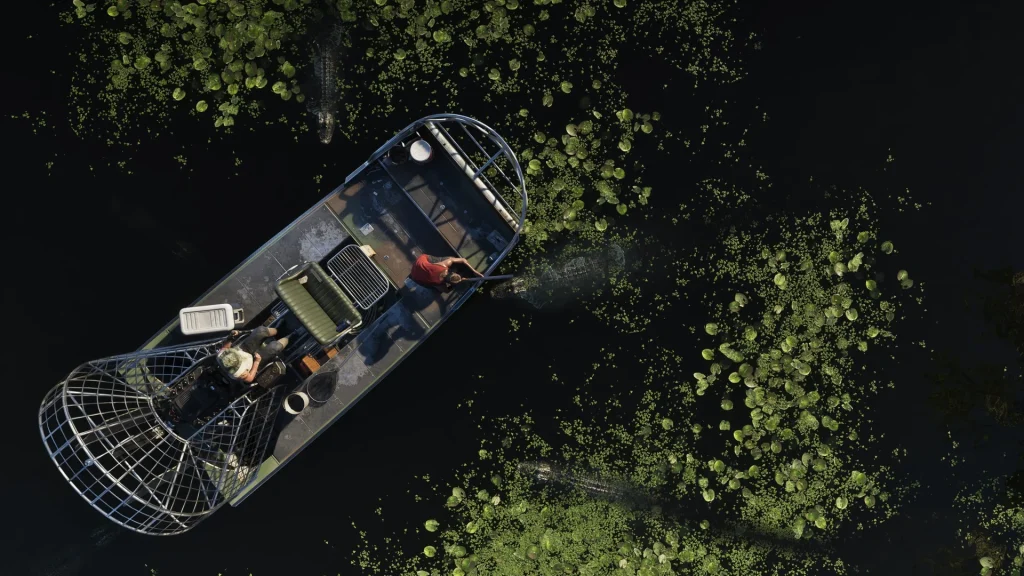
Grand Theft Auto VI’s official Leonida material separates the Grassrivers from the beaches and city streets around it. The wetland environment changes how players read distance, choose vehicles and stay visible. It can make travel itself a decision, especially when open water, narrow channels and wildlife replace the clear road grid of Vice City.
Water routes do not behave like city streets
A city map provides lanes, junctions and named roads. Wetlands have fewer clear boundaries. A route may look direct but become shallow, narrow or blocked by vegetation. Players must read the surface and the banks rather than follow a line painted on asphalt. That difference can make a short journey feel genuinely unfamiliar.
Navigation remains fair when the environment supplies clues. Boat wakes, markers, buildings on stilts and changes in vegetation can indicate a usable channel. The strongest design teaches those clues through repeated travel, allowing experienced players to find a faster or quieter path without turning the area into an invisible maze.
Vehicle choice becomes part of preparation
A sports car that dominates a highway offers little value in deep water. Boats, airboats and capable off-road vehicles can create separate movement plans. The player may choose speed and noise on an open channel or a slower approach with more cover along the bank. Each option should expose a different risk rather than one vehicle solving every problem.
Transitions between land and water are equally important. A mission can become frustrating if the player reaches shore but cannot understand where to leave the boat or find transport. Clear docks, ramps and places to come ashore let the change of vehicle feel intentional. They also create places for pursuit, ambush and recovery.

Visibility can work in both directions
Open water gives a long view, but it also makes the player easy to see. Reeds and trees provide concealment while restricting the camera and slowing movement. This creates a natural choice between information and protection. A route through cover may be safer from distant observation but more vulnerable to a close-range attack.
Police pursuit and enemy searches can use the same logic. Air support may control open ground, while boats can block obvious channels. The player needs routes that break sight without depending on a scripted hiding place. If weather and time of day alter visibility, familiar paths can demand a different plan on another visit.
Wildlife should affect attention without becoming noise
The Grassrivers imagery emphasises a living ecosystem. Wildlife can make the region feel active even when no mission is running, but it should not interrupt every journey. The best encounters give information, atmosphere or a manageable hazard. Constant attacks would reduce a distinctive environment to a repeated obstacle.
Animal behaviour can also signal the player’s impact. Birds leaving a quiet bank or movement in shallow water may reveal that something has changed before another person appears. These details make the landscape readable. They work when used selectively and when the player can understand the cause instead of treating every sound as random danger.
The region broadens the meaning of an open world
A large map is not valuable only because it takes longer to cross. The Grassrivers add scale by requiring another way of thinking. Roads are less reliable, vehicles have stronger specialisation and visibility changes with the route. Those differences can make the journey relevant to the objective rather than a pause between objectives.
Rockstar has confirmed the environment and shown its visual character, while specific mission systems remain to be tested in the finished game. Players should not expect every piece of water to hide a unique event. They can reasonably expect the wetland to give Leonida a style of travel that cannot be copied directly from Vice City or Port Gellhorn. Travel through the Grassrivers can also change the pace of a session. Open roads encourage speed, while narrow water channels make route knowledge and vehicle choice more important than raw power. Wildlife, weather and limited visibility can add pressure without becoming constant obstacles. The area will feel convincing if players learn recognisable landmarks and shortcuts over time. It should give players a reason to leave the main road and offer a route, encounter or resource that could not appear in the city.