

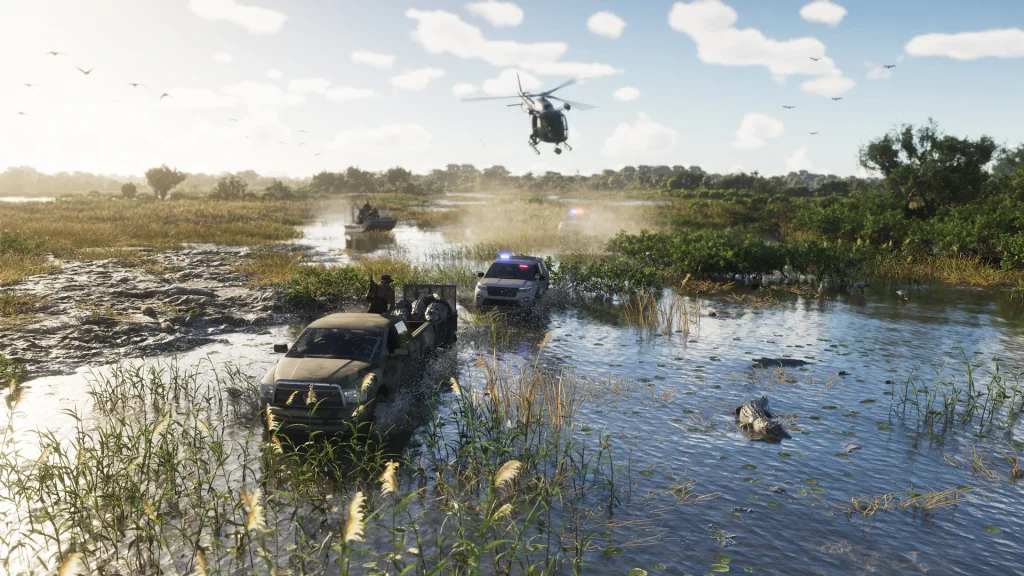
Official Grand Theft Auto VI footage shows police cars, armed officers, boats and helicopters applying pressure in very different parts of Leonida. The scenes do not reveal a complete wanted-system rulebook, but they do show why escape planning may depend on visibility and terrain as much as raw vehicle speed.
Air support makes an open route dangerous
A fast car or boat can build distance from ground units while remaining easy to follow from above. In the Grassrivers footage, the helicopter keeps contact across water and low vegetation, where the player has fewer tall structures to break the line of sight. Aerial tracking also raises a communication question. Search lights, rotor sound and the direction of the helicopter can warn the player where observation comes from, allowing cover to be chosen without relying on a hidden rule.
That creates a clear navigation problem. A long straight route may look fast on the map but offer no cover, while a slower turn beneath a bridge, beside dense buildings or through changing elevation could interrupt observation and create a safer second route.
A road block tests decisions made several seconds earlier
Multiple police vehicles can close the obvious exit before the driver reaches it. The useful response begins with reading traffic, side streets and the width of the approaching junction, not with a last-second turn after the obstruction fills the screen.
A believable chase needs those barriers to remain readable. Lights, radio warnings, civilian reactions and the direction of arriving units can tell the player where pressure is building, allowing a risky choice to feel like a decision rather than a hidden penalty. Vehicle damage may narrow the choice before a road block appears. A fast car with poor steering or damaged tyres can make a smaller side street less useful, so the condition of the vehicle becomes part of route planning.
Police pressure works differently on the water
Boats can move away from road-based units, but open water reduces the number of corners and physical obstacles available for concealment. A police helicopter or patrol boat can maintain a clean view for longer, so acceleration alone may not be enough to end the pursuit. Changing from road to water may break one layer of pursuit while attracting another. A useful transition point therefore needs both access to the shore and a second route after the boat enters open water.
Shorelines, bridges, marinas and narrow channels could become the useful equivalents of alleys and parking structures. The footage confirms the presence of these environments; how consistently they affect police awareness will only be clear through ordinary play.
Jason and Lucia may divide attention inside a vehicle
Several scenes place the protagonists together during dangerous movement, making it possible for one person to drive while the other watches or responds to a threat. That visual co-operation supports the story even before any detailed character-switching rules are known.
Coverage should stop at what the footage demonstrates. Rockstar has shown two characters acting together, but it has not published a complete account of when control can change, how companions choose targets or whether every chase supports the same actions. Civilian reactions can communicate danger without adding another meter. People who move away, record the scene or call for help can show that attention is increasing, provided those reactions remain varied and connected to what happened nearby.
Each district can ask for a different escape plan
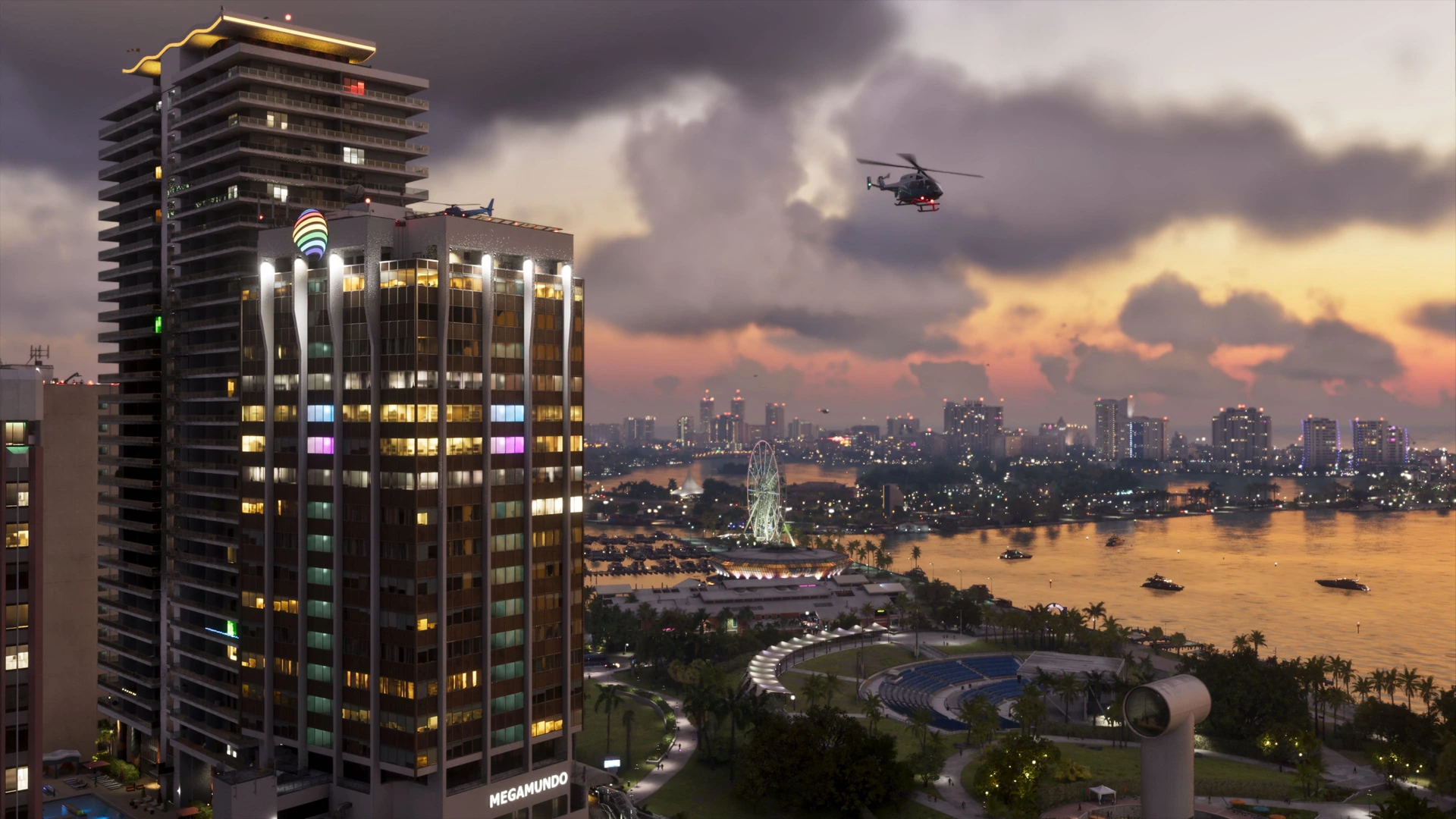
Vice City offers dense junctions and vertical cover, while highways, the Keys and the wetlands create longer sight lines and fewer immediate turns. If police units use those differences, the map can change the logic of a chase instead of only changing its background.
The strongest test will come outside scripted missions. A consistent system should let players learn why pursuit intensifies, identify a practical way to reduce visibility and apply that knowledge in another district without expecting every area to behave identically.