

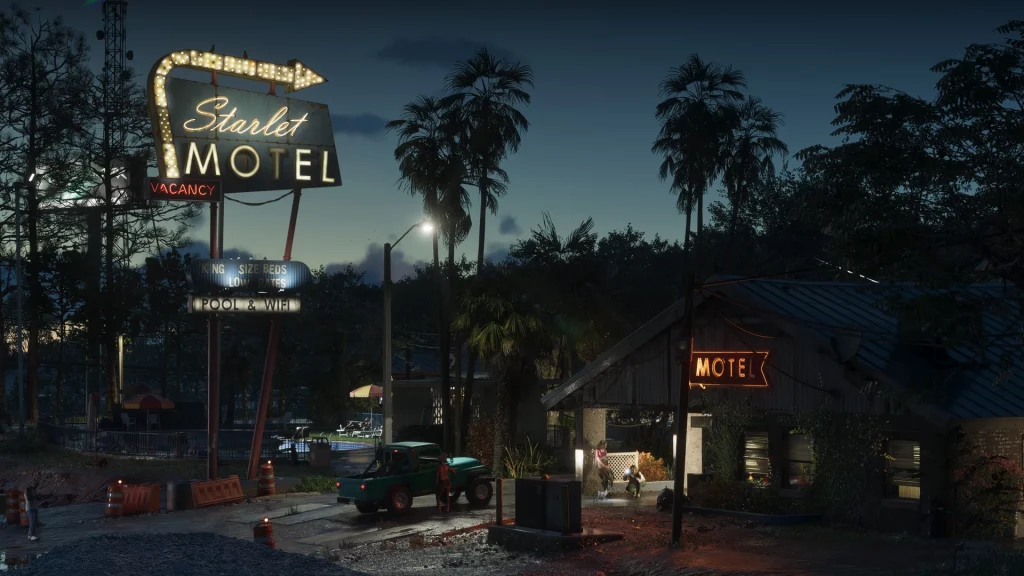
Rockstar’s official Grand Theft Auto VI material presents Port Gellhorn as more than a roadside stop. The former tourist destination is worn down, but its motels, strip malls, pawn shops and informal businesses still create movement and opportunity. The location can support a different pace from Vice City’s dense centre without becoming an empty stretch between missions.
Decline gives the district a visible history
Port Gellhorn is built around places that have already served another purpose. Faded attractions, tired signage and businesses operating on thin margins suggest a town that once expected more visitors. This is useful environmental storytelling because the player can read economic change before a character explains it.
A believable worn-down location needs variation. If every building is abandoned, the area becomes a decorative ruin. Active stores, traffic, workers and local customers show that the community has adapted rather than vanished. That mixture gives the district reasons to be visited during ordinary play as well as during scripted missions.
Small businesses can support compact missions
Pawn shops, motels and strip malls create many short destinations close to one another. They can support purchases, contacts, surveillance or brief encounters without requiring a major landmark. A player moving through the district should be able to identify useful buildings from their shape and frontage instead of relying entirely on map icons.
The same layout can produce several approaches. A rear service lane may offer a quieter entry, while a busy car park gives cover but more witnesses. Good open-world design lets the environment explain those trade-offs. The town’s commercial pattern is therefore not only visual background; it can become a practical layer of mission planning.
Roads connect the town to the wider state
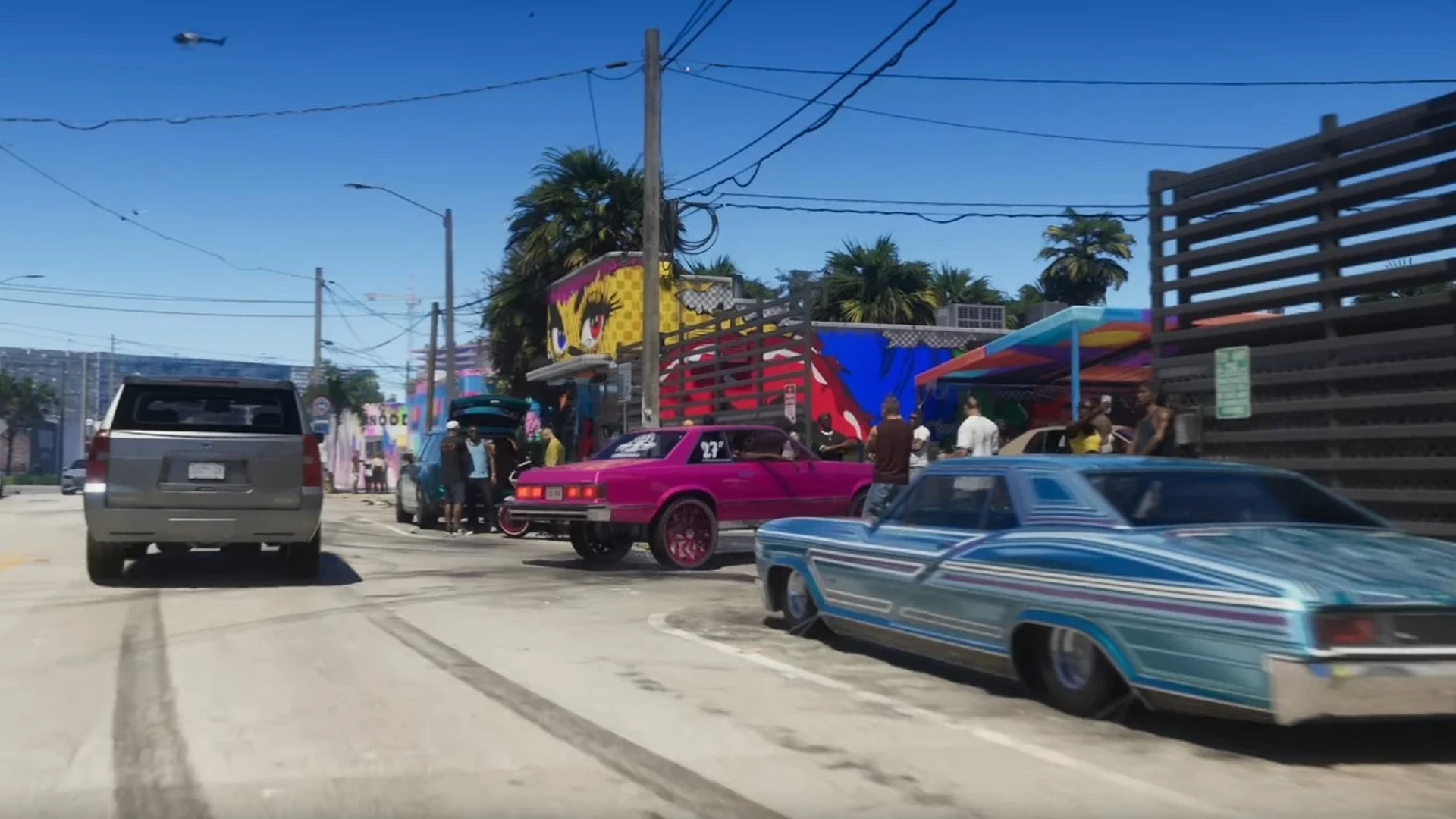
Port Gellhorn appears suited to journeys that begin or end outside its centre. Highways, service roads and low-rise blocks create a different driving rhythm from the tight streets of Vice City. Faster approaches can make vehicles more important, while limited junctions can turn police pressure into a route-selection problem.
The district should still provide local alternatives to one main road. Alleys, yards and secondary streets make escape feel learned rather than predetermined. A player who studies the area can trade speed for cover or visibility. That is a stronger use of geography than simply placing a long straight line between two objectives.
Legal shops and illegal deals can share the same streets
Rockstar’s description suggests legitimate and illicit activity operating beside each other. That overlap is central to Grand Theft Auto: a normal business may become a contact point, a front or an obstacle depending on the mission. The contrast works best when pedestrians continue their routines instead of existing only as witnesses to the player.
Local characters also need motives tied to the place. Someone protecting a small business, collecting debt or trying to leave the town has a reason to care about Port Gellhorn’s decline. These motives can produce conflict without importing every story from Vice City. The location gains identity when local problems drive local missions.
A quieter location can improve the scale of Leonida
Vice City supplies density, neon and public spectacle. Port Gellhorn can make that centre feel larger by contrast. A change in road width, building height, traffic and ambient sound tells the player that the state is not one continuous city. Travel becomes meaningful when the destination alters what actions feel natural.
The current official material confirms the tone and visible details, not every activity that will appear. The careful conclusion is that Port Gellhorn has been designed as an inhabited, economically specific region. Its success will depend on whether missions, traffic and local systems use that identity instead of treating it as scenery around a highway. Port Gellhorn therefore works best as more than a stop between larger missions. Its motels, workshops, small stores and roadside businesses can make money feel connected to place, especially if prices, opportunities and police attention change with the player’s choices. A town with modest rewards may still remain valuable when it offers discreet preparation or a safer route across the map. That kind of local purpose would distinguish it from Vice City’s richer districts without turning the area into empty scenery.