

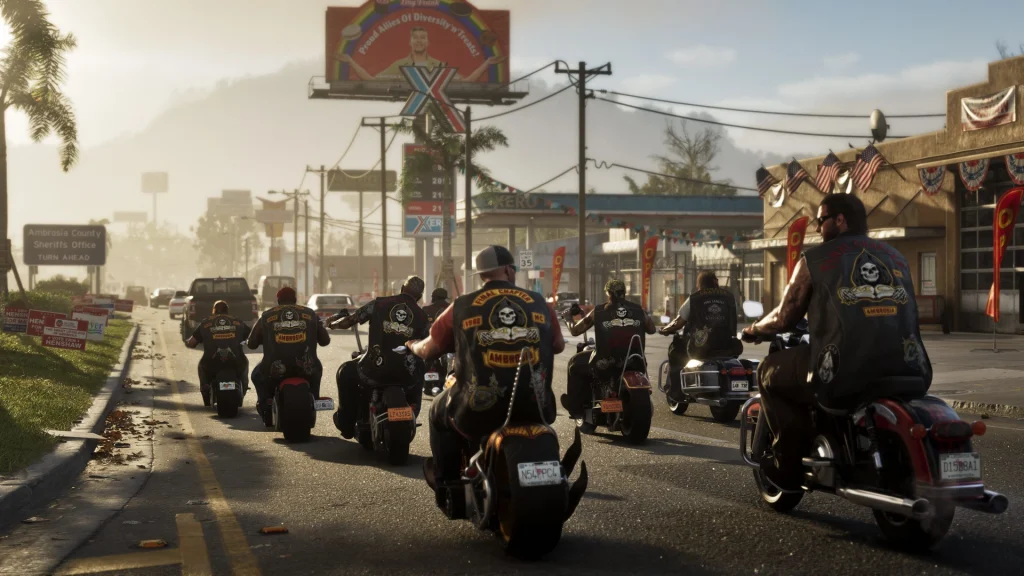
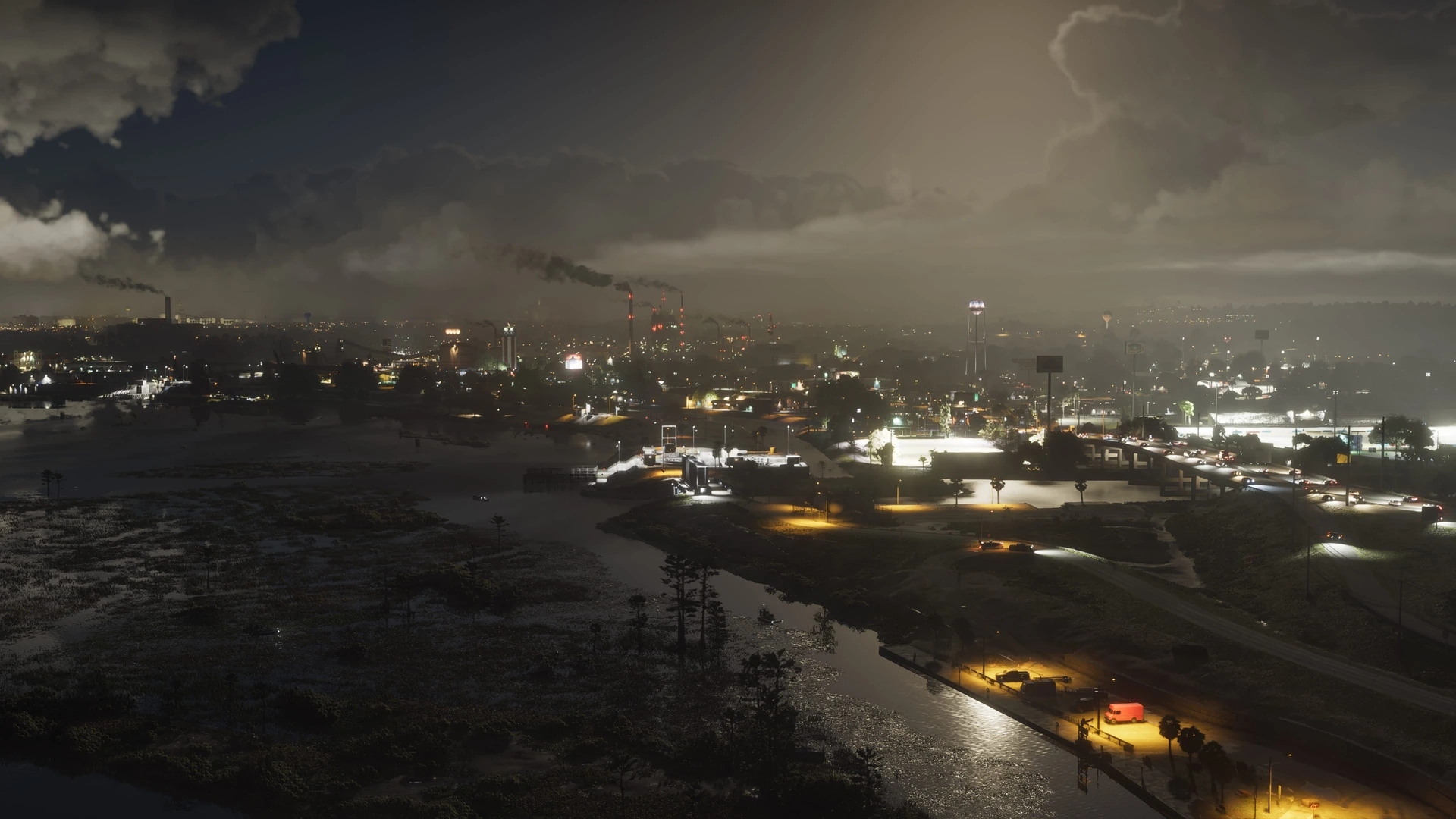
Ambrosia is presented as Leonida’s industrial heart, where Allied Crystal’s sugar refinery employs the town and the Final Chapter motorcycle club supplies much of what the company does not. That combination gives GTA VI a region whose conflicts can grow from wages, transport, land and personal loyalty rather than another generic urban robbery. The town can feel convincing if its factory, housing, roads and informal economy depend on one another throughout ordinary play.
The refinery should shape the town beyond its skyline
A large industrial employer changes daily movement. Shift changes fill certain roads, freight vehicles follow repeated routes and businesses become busiest at predictable hours. The refinery’s presence can be felt even when the player is not inside it. Workers talk about schedules and safety, local shops depend on paydays, and a disruption at the plant affects traffic and prices across Ambrosia.
Environmental design can communicate this relationship without forcing every character to repeat the same exposition. Company signs, protective equipment, rail sidings and housing built near the workplace tell a history. Cleaner offices and worn production areas can reveal who benefits from the arrangement. The town becomes a system with visible winners and risks, not just a factory object placed behind a fence.
Final Chapter can operate as an alternative institution
The biker gang is described as providing almost everything else. That phrase suggests influence built through services as much as intimidation. Members may arrange transport, security, parts, loans or access to goods that the formal company structure does not provide. Residents can distrust the gang while still depending on it, creating relationships more complicated than a map filled with permanently hostile enemies.
For the player, reputation should affect access and information. Helping one member may open a workshop or reveal a freight route, but it can also create expectations from the wider chapter. Conflict inside the club would be more interesting than a single leader representing every opinion. Some members can protect local business, others can chase profit, and both groups may claim they are defending Ambrosia.
| Power centre | Influence in Ambrosia |
|---|---|
| Allied Crystal | Jobs, industrial land and formal transport |
| Final Chapter | Informal services, workshops and local contacts |
| Workers | Operational knowledge and access shaped by shifts |
| Freight network | Routes that connect the refinery to the wider state |
Industrial jobs offer problems beyond direct theft
A refinery supports missions about schedules, maintenance, documentation and hazardous access. A crew might need a uniform and a valid vehicle instead of heavier weapons. Changing a delivery record can move valuable cargo into a reachable yard; disabling one system can create a diversion but also endanger workers and close the only safe route. The best solution depends on how much disruption the characters are willing to cause.
Those jobs also make reconnaissance worthwhile. Watching the facility at two different hours can reveal a gate that looks impossible during the day and nearly empty during a shift change. Talking to a worker can replace an expensive piece of equipment. A loud assault remains possible, but it becomes one choice among several rather than the only way the industrial setting affects play.
Freight roads can make heavy vehicles useful
Ambrosia should have movement patterns distinct from Vice City’s fast avenues or the Keys’ water routes. Tankers, tractors and freight trains create slower obstacles and valuable cover. A small sports car can pass traffic easily but may fail on rough service roads or when the job requires moving equipment. A truck is conspicuous and slow, yet it can enter spaces where an unfamiliar pedestrian would be challenged.
Vehicle choice becomes part of identity. A company-marked cab may pass a gate but be reported quickly after a crime. A club motorcycle reaches side paths and disappears between buildings but carries little cargo. Switching vehicles halfway through a job can solve both limitations, provided the transfer point was prepared. The town rewards logistical planning rather than top speed alone.
Loyalty should create consequences that remain local
A one-company town can react strongly to a small action because the same people meet at work, home and local businesses. Damaging the refinery may reduce company control but also remove shifts from families the protagonists know. Supporting Final Chapter can secure protection while making independent residents feel trapped. Those effects do not need a single morality meter; changes in dialogue, available help and visible activity can carry the consequence.
Local reactions are more credible when they are uneven. A mechanic may appreciate stolen parts, a worker may resent a shutdown and a manager may quietly benefit from evidence disappearing. The player then learns who holds power through repeated contact. Ambrosia should remember specific disruptions without making the entire state respond identically to one regional choice.