

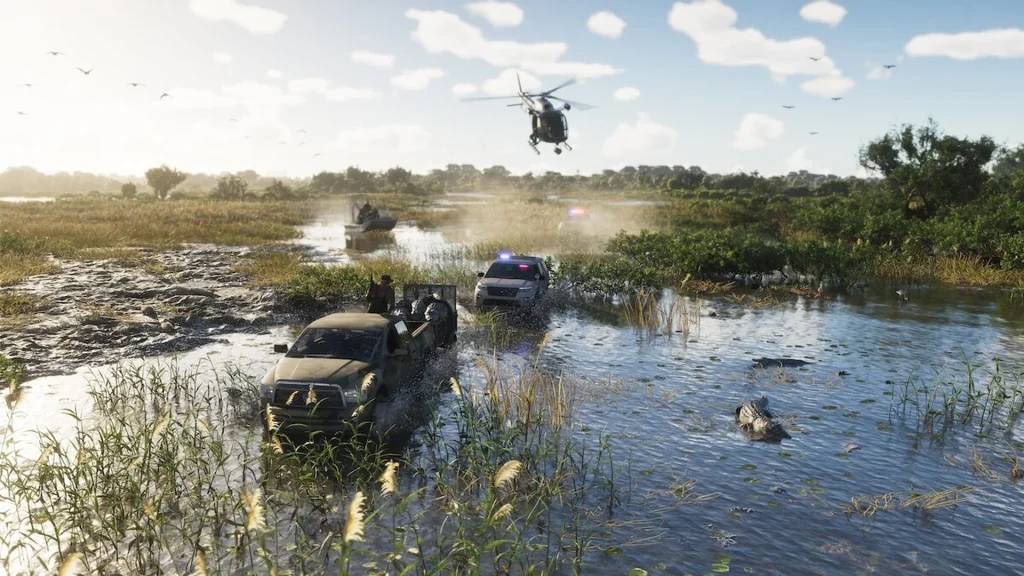
Grand Theft Auto VI will populate Leonida with more than 170 animal species across land, air and sea. Rockstar’s list reaches beyond alligators and flamingos to manatees, pelicans, green iguanas, cane toads, feral cats and rhesus macaques. Certain animals can be tracked as Rare, Discoverable or Legendary, giving wildlife a collection and exploration structure that is separate from the game’s criminal missions.
The population mixes native and invasive species
Leonida is designed as a Florida parody, so its wildlife includes animals associated with the region and species introduced from elsewhere. Flamingos, manatees, pelicans and alligators share the state with green iguanas, cane toads, feral cats and rhesus macaques. That mixture matters because Florida’s ecological identity is not a tidy catalogue of only native animals.
Different populations can also help distinguish locations. A coastal inlet, wetland, suburban canal and inland road should not draw from the same visible set at the same frequency. More than 170 species provides enough breadth for regional patterns, but the quality of the system will depend on placement and behavior. A large count loses value if every animal appears as a random decoration anywhere on the map.
Land, air and sea require separate observation
Rockstar has confirmed animals across all three environments. The player may need to look above road level, stop near water or leave the center of Vice City to encounter much of the list. That distributes discovery across travel methods instead of placing every entry on the edge of the highway. Boats and aircraft can therefore reveal life that a normal car route never exposes.
Observation must remain readable at GTA’s usual speed. Birds and small animals can disappear before the player identifies them, while underwater species need clear water and camera behavior. Slower exploration tools, a record of discovered species or strong audio cues would make the system more approachable. Rockstar has confirmed tracking categories, but has not yet shown the complete discovery interface.
| Wildlife detail | Confirmed information |
|---|---|
| Scale | More than 170 animal species |
| Habitats | Land, air and sea |
| Examples | Flamingos, manatees, pelicans, alligators, iguanas, macaques |
| Tracking | Rare, Discoverable and Legendary categories |
| Rendering | New fur, hair, feather, translucency and bioluminescence work |
Rare, Discoverable and Legendary labels create a hierarchy
Some creatures are categorized for tracking as Rare, Discoverable or Legendary. The names of the harder targets remain secret. This structure suggests that seeing an animal can be more than background ambience: the player may have a reason to recognize, locate or document a particular creature under specific conditions.
The categories should not be treated as confirmation of hunting rewards or mandatory combat. Tracking can support photography, observation, collection records or story events. The distinction is important because wildlife can enrich Leonida without turning every encounter into a resource. Until Rockstar explains the reward loop, the safe conclusion is that selected species have formal discovery status.
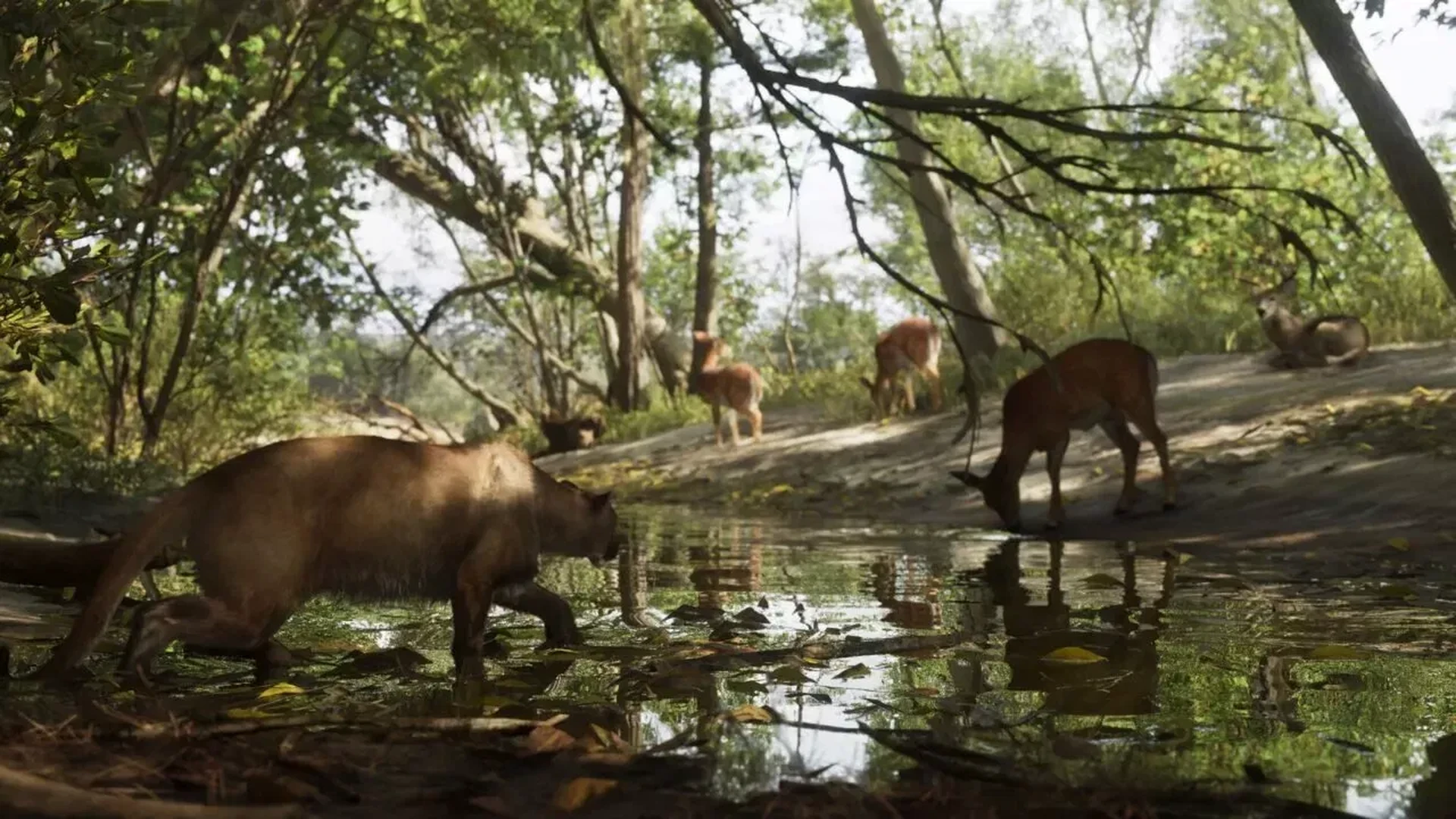
Rockstar is extending its Red Dead technology
The studio is building on work from Red Dead Redemption by adding material details such as iridescence, bioluminescence, translucency, feather types and new hair and fur systems. Those features address how an animal reacts to light and distance, not just the shape of its model. A wet bird, translucent sea creature and animal seen under neon should not share the same surface response.
The challenge is maintaining those details in a dense modern world. Traffic, crowds, reflections and weather already compete for processing time. Wildlife has to look convincing without causing sudden performance drops whenever several species enter view. Scalable density and level of detail will be especially important in wetlands and coastal areas where land, air and water populations can overlap.
Animals can make ordinary travel less predictable
A creature crossing a rural road, birds reacting to noise or an alligator near shallow water can change a route without becoming a scripted mission. These events make the environment answer the player’s speed and presence. They also require fair signaling: an animal that affects driving should be visible early enough that avoiding it is a decision rather than a random collision.
Urban wildlife can serve a different role. Feral cats, iguanas and birds can show how a neighborhood uses its space and how close the natural and built environments sit in Leonida. The most convincing world will not display wildlife constantly. Quiet periods, seasonal conditions and habitat boundaries make an encounter memorable because it belongs to a place instead of following the player everywhere.