

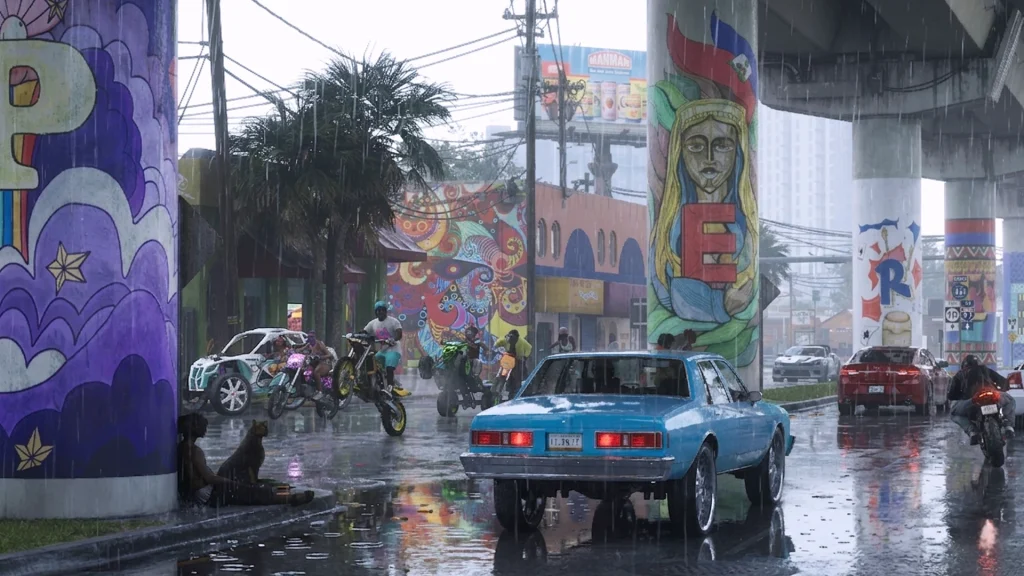
Rockstar has explained how Grand Theft Auto VI models Leonida’s tropical weather. Storms can remain localized, allowing a player to stand under clear sky and watch rain fall elsewhere, while puddles and wet surfaces persist after the cloud has moved on. Tropical storms and hurricanes are also confirmed parts of the system. The new information is about how the state changes over time, not another repeat of the game’s release platforms or date.
Weather can occupy one part of the state
Localized rain means a weather event does not have to place the entire map under one global filter. A dark cloud can become a visible destination, boundary or warning. The player may approach a wet district from dry roads and understand that conditions are changing before the first drop reaches the current location. That transition is more useful than an instant switch applied everywhere at once.
The system also gives distant scenery a gameplay role. A storm on the horizon can influence route choice even if the player never enters it. Someone carrying out a time-sensitive drive may avoid the area, while another player may choose it because reduced visibility changes pursuit. Rockstar has confirmed the spatial behavior, but has not yet detailed every mechanical consequence, so those uses remain reasonable possibilities rather than promised features.
Persistent wet surfaces preserve the history of a place
After localized rain passes, puddles and reflective surfaces remain. That persistence lets a district show what happened before the player arrived. A dry windshield does not mean the road ahead has normal grip or visibility, and the wet environment can visually connect two moments that would otherwise feel like unrelated weather presets.
Small traces also make travel more coherent. Driving from bright sun into a recently soaked neighborhood should feel like crossing a real weather boundary, not loading a new effect. The strongest implementation will keep those traces readable without covering every street in exaggerated reflections. Water needs to communicate recent rain while preserving road markings, pedestrians and obstacles.
| Weather feature | Confirmed behavior |
|---|---|
| Storm coverage | Rain can remain localized to part of Leonida |
| After the rain | Puddles and wet surfaces persist |
| Sky | Dynamic cloudscapes move through different conditions |
| Rare light | Rainbows can appear after showers |
| Severe weather | Tropical storms and hurricanes are present |
Dynamic clouds make prediction possible
Rockstar describes cloudscapes that move across Leonida from clear conditions into overcast weather and rain. If the motion remains consistent, players can learn to read direction and density before a storm arrives. That gives the sky practical information. It can warn an aircraft pilot, change the mood of a coastal journey or signal that a planned photograph will soon have very different light.
A rainbow may appear under the right lighting after a shower. The detail is cosmetic, but it demonstrates that the system connects precipitation, cloud position and sunlight rather than selecting an isolated sky image. Those connections help the world feel continuous, especially when the player remains outdoors long enough to see the whole sequence from buildup to clearing conditions.
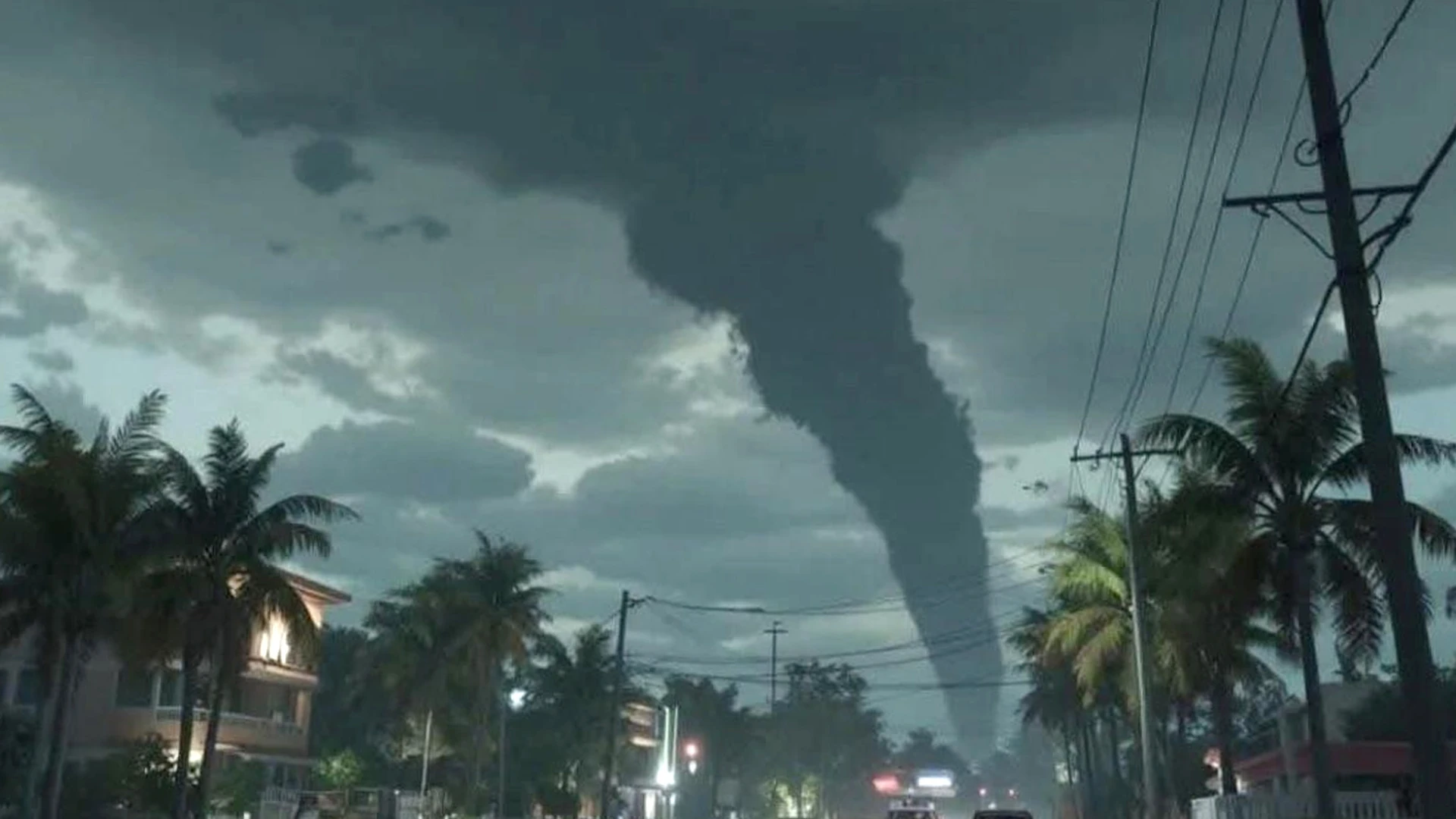
Hurricanes are confirmed but their rules remain unknown
Leonida includes tropical storms and seasonal hurricanes, reflecting the Florida climate that inspires the state. The confirmation does not yet establish frequency, map damage, mission behavior or whether every hurricane can occur during free exploration. Treating any of those details as settled would go beyond what Rockstar has disclosed.
The unknowns are important because a hurricane can serve many different purposes. It might frame a specific story sequence, alter normal travel for a limited period or exist as a rarer systemic event. Each choice has consequences for missions and persistence. A tightly directed storm can support drama; a fully dynamic one needs rules that prevent it from repeatedly disrupting activities without giving the player meaningful decisions.
Different vehicles should reveal different risks
Wet roads matter most when vehicles do not react identically. A motorcycle, high-performance car, heavy truck and small boat should expose separate problems as rain changes visibility and surface conditions. Even modest differences in braking or steering can make route selection relevant without turning every shower into an uncontrollable slide.
Aircraft face another layer: cloud cover and violent weather can hide terrain or complicate a low route. Boats can encounter an open coast that feels safe in clear weather and exposed once wind and waves build. Rockstar has not published a full physics specification, so the confirmed point remains environmental variety. The design opportunity lies in letting each form of transport read that environment in its own way.